Someone told us to keep the digital simple. We have concerns.
Keep the experience simple. Keep the checkout user friendly. Keep your reporting easy enough that you don't need Nathan from accounts and a minor in data science to understand what happened last August.
But your creative?

That's where we have concerns.
Simple creative has an unfortunate habit of becoming safe creative. Safe becomes familiar. Familiar becomes invisible. And invisible is a very expensive thing to be when you're paying for every impression.
We don’t want to make marketing complicated. I don’t think anyone does.
The goal is to make it worth noticing.
The internet has enough perfectly acceptable advertising
We have access to more customer data, targeting technology, automation and optimisation tools than marketers could have dreamed of twenty years ago. We can find incredibly specific audiences, follow behaviour across a customer journey, test twenty-seven variations of an ad and receive a lovely dashboard telling us precisely how many people ignored version B.
And yet, for all this sophistication, we seem to be producing an extraordinary amount of marketing that looks exactly the same.
Same stock photos and carefully restrained colour palette. Same three-word headline. Then enter the boring claim about quality, innovation or service. Add a smiling person looking suspiciously delighted to be discussing business insurance… As Pam would say…
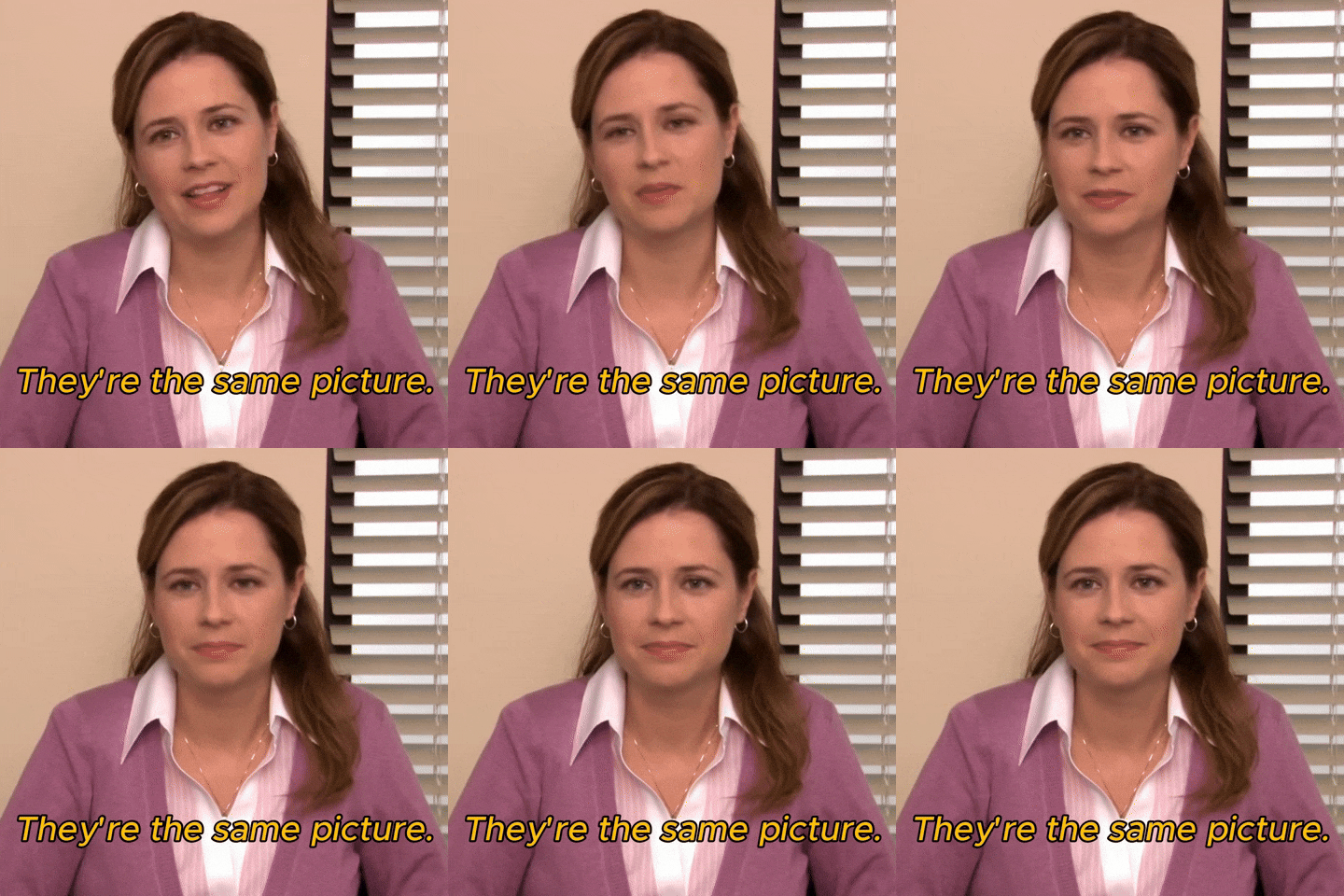
It's all perfectly fine.
But that's the problem. Nobody remembers perfectly fine.
And if you're spending $1,000, $5,000 or $50,000 putting something in front of people, being forgettable becomes a very expensive creative decision.
Great creative doesn't make marketing pretty. It makes the money work harder.
This is the part where creativity sometimes gets misunderstood.
Creative isn't the decorative layer added once the serious marketing people have finished discussing budgets, channels and ROAS. The quality of the creative can materially affect how hard that media investment works.
Kantar and WARC matched around 450 ads from Kantar's creative-testing database with campaign profitability data from WARC. Their analysis found that the most creative and effective advertising generated more than four times the profit of low-quality creative.
Kantar's more recent work goes further, reporting that creative quality can amplify media effectiveness by 50% or more.
Think about what that means commercially.
You can obsess over shaving a few dollars off your cost per click. You can fiddle with audiences. Change placements. Increase budgets. Decrease budgets. Have a very serious meeting about the button.
Or you can look at the thing you're spending all that money putting in front of people and ask a far more uncomfortable question.
Is it any bloody good?
Poor creative doesn't simply fail to make an impression. You often have to keep paying to give it another chance.
Another impression. Another campaign. Another retargeting ad following someone around Instagram like a needy ex.
You keep buying attention because the creative isn't earning enough of it.
The problem isn't simplicity. It's what gets removed in pursuit of it.
To be clear, we love simplicity in the right places.
Your customer should understand what you do. Your website shouldn't require an orienteering badge. Your checkout shouldn't feel like applying for a mortgage. Your reporting should tell you something useful without needing three people to translate it.
Simplicity and getting to the point is incredibly important.
But clarity and creative simplicity aren't the same thing.
Some of the best creative in the world is visually restrained. The difference is the idea. We're not arguing for complexity. We're arguing against sanding every interesting edge off your marketing until you're left with something technically correct and emotionally beige.
Sometimes the right idea is restrained. But others it's funny, strange, confronting or outrageous enough that someone sends it to their work group chat asking, “Who approved this?”
Good.
They noticed.
Facts explain the product. Stories explain why anyone should care.
People need information. Of course they do. Price matters. Features matter. Specifications matter. Proof matters.
But information on its own rarely creates much of an emotional response.
“Advanced lumbar support” is useful information.
Dave starting the day sitting upright and gradually folding himself into the shape of a prawn by 4.47pm is a story.
And if your audience has spent the last three years working at a desk thinking Jesus, that's me, you've created recognition before you've even mentioned the product.
Now tell them about the lumbar support.
This is something we come back to constantly in brand strategy. People need to see the relevance of what you're selling in their own lives. The strongest creative doesn't simply describe the product accurately. It makes the problem, desire or outcome feel familiar enough that somebody recognises themselves inside it.
That's when the feature starts to mean something.
Emotion isn't the fluffy bit
There's a slightly odd division that still exists in marketing where performance is treated as commercial and emotion is treated as the nice creative bit.
The research doesn't support that separation particularly well.
System1 and Pinterest research found that digital ads creating stronger positive emotion produced 20% higher ad-recall lift and six times higher action-intent lift. Their analysis also found that ads leaving people feeling more positive achieved 47% higher ROAS, while creative that sustained attention achieved 2.7 times higher ROAS.
That doesn't mean every campaign needs to make somebody cry into their Weet-Bix.
Emotion can be humour. Curiosity. Relief. Desire. Recognition. Surprise. Aspiration. Even mild outrage.
What matters is that something happens. FYI neutrality is a terrible place for a brand to live.
If somebody sees your advertising and feels absolutely nothing, remembers absolutely nothing and continues scrolling without the slightest interruption to their day, you technically reached them.
Congratulations.
Your dashboard may even count it.
Commercially, however, that impression hasn't done a great deal.
And this is where performance marketing can get a little backwards
We love data.
Data tells us what people clicked, where they came from, what they watched, where they dropped off and what eventually converted. Used properly, it's incredibly valuable.
But because digital marketing gives us so much measurable information, we've become very good at optimising the things that are easiest to count.
Sometimes at the expense of asking if the idea itself is strong enough.
Google, Kantar and Marketing Week published research in 2025 involving 1,091 UK marketers. Eight in ten said creative quality was a key driver of effectiveness, yet fewer than half were measuring its impact.
Which is fascinating. We know creative matters. We know it affects performance. And then we spend three hours discussing a 0.2% change in click-through rate while nobody asks why the ad looks like every other ad in the category.
This is not an argument against performance marketing.
It's an argument for giving performance marketing something better to perform with.
So should you keep your digital marketing simple?
Parts of it, absolutely.
Make the experience simple. Make buying simple. Make your navigation intuitive. Make your strategy clear enough that everyone involved understands what you're trying to achieve.
Then give the creative some teeth.
Build an idea around something your customer cares about. Tell a story. Find the emotional layer. Make them laugh if that's right for the brand. Make them uncomfortable if that's right. Be beautiful. Be ridiculous. Be incredibly restrained.
Just don't make “simple” the creative objective.
There is already enough advertising in the world that is clean, polished, professional and almost completely impossible to remember.
And when you're paying for every opportunity to be noticed, forgettable gets very bloody expensive.
That's the bit we'd rather keep simple.